Wire-Free vs Boundary-Wire Robot Mowers: Which Fits
Wire-free vs boundary-wire robot mowers: installation effort, wire distances and limits, sky view, repairs, and which suits your lawn shape.


A boundary-wire robot mower follows a cable you peg or bury around the lawn, so it works on any shape and under any tree but takes an afternoon to install. A wire-free mower draws the edge in an app and finds it with RTK satellites, cameras or LiDAR, which saves the wire but asks for open sky or good landmarks. Lawn shape, tree cover and how often you redesign the garden decide which fits.
Affiliate disclosureAs an Amazon Associate we earn from qualifying purchases. Commissions never change our ratings.
How each one knows where to stop
With a wire, a weak signal runs through a loop around the lawn and the mower turns when it senses it. Islands such as a tree or a bed get their own loop, with the two wire runs to and from the island laid side by side in the same peg, per Husqvarna. A wire-free mower stores a map: you drive it once along the edge with the app and it later locates itself with corrected satellite positions, cameras, LiDAR or a mix. The edge becomes a line you can move in a minute.
What the wire costs you in time and rules
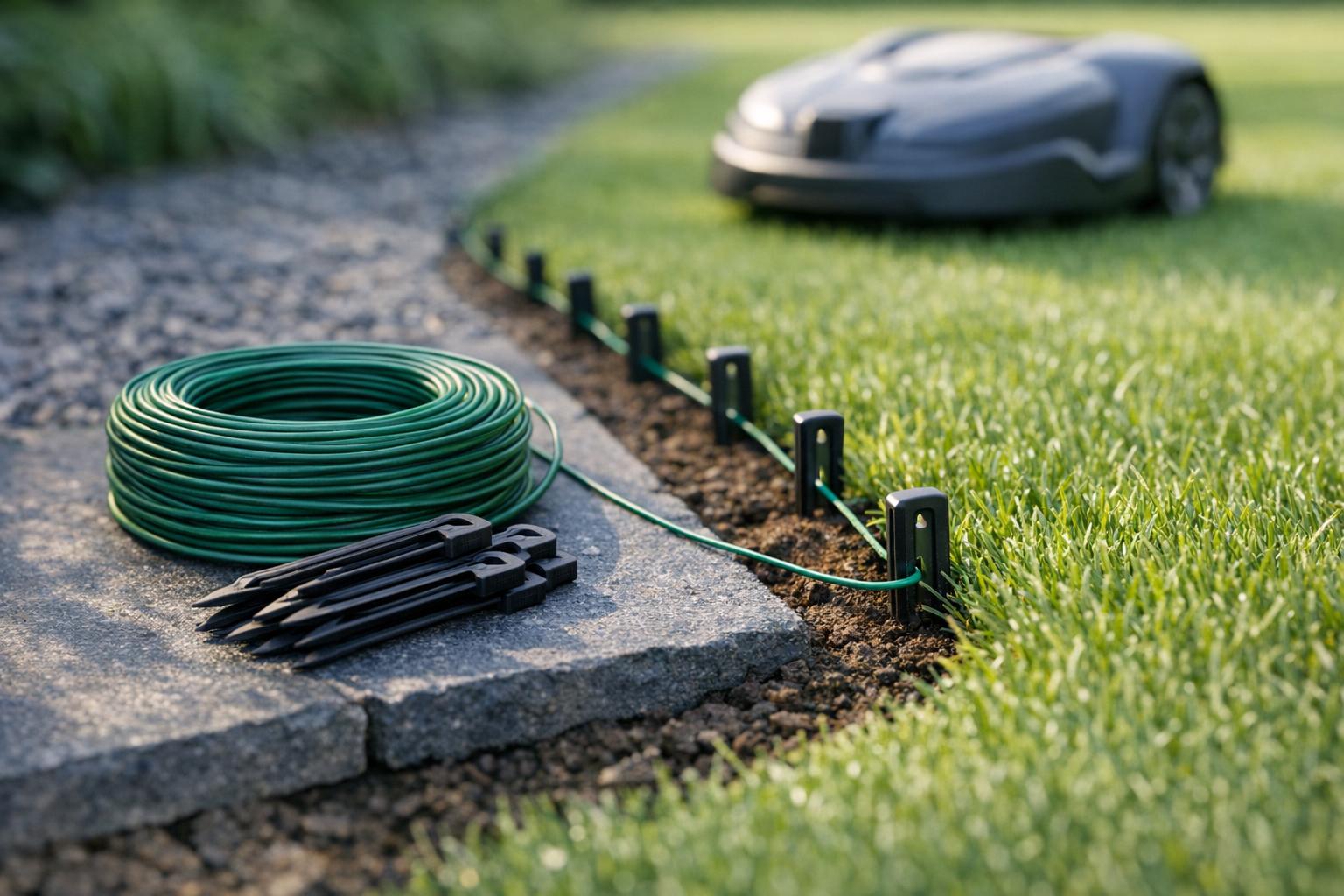
- Distances: 35 cm (14 in) from walls and raised beds, 30 cm from low obstacles, 10 cm (4 in) from a flush path (Husqvarna, Gardena).
- Pegs every 100 cm (40 in) at most, or buried 1 to 20 cm deep (Gardena).
- Maximum loop length: 300 m on the Gardena SILENO minimo, 800 m on the Husqvarna Automower 520/550.
- Passages at least 60 cm between wires, about 51 in between two walls once the distances are added (Gardena).
- Slopes: along an outer edge steeper than 15 % (Husqvarna 520/550) or 10 % (Gardena minimo) the wire moves 20 cm (8 in) in from the edge.
Repairs are the long-term cost: a dethatcher or an edging spade can cut a wire on the surface (Husqvarna says to bury it if you dethatch), and the mower stops until you find the break.
What wire-free asks of your yard
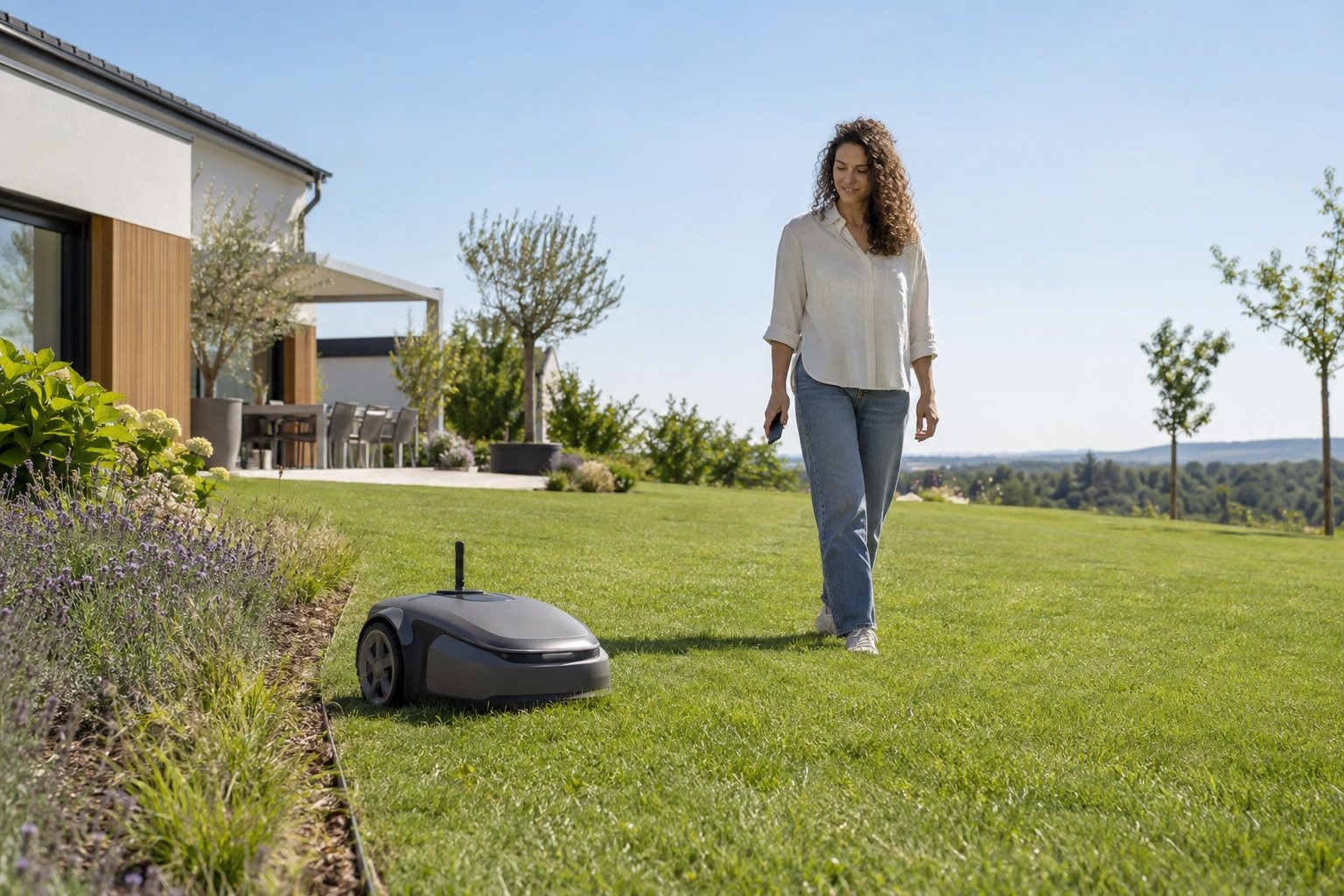
RTK needs sky for both the antenna and the mower. Navimow wants the antenna more than 2 m (6.6 ft) from houses, trees and walls; GPS.gov notes that satellite accuracy degrades near buildings and trees. Cameras need light and a visible edge, and LiDAR needs fixed objects to measure against. Wire-free models also depend on the app and often on a connectivity module. In exchange you add a no-go zone for a new bed or a party in the app, and nothing is buried.
Side by side
| Boundary wire | Wire-free (RTK, vision, LiDAR) | |
|---|---|---|
| Installation | lay and peg the loop, islands, guide wire | place station and antenna, map with the app |
| Any lawn shape | yes | yes, if sky or landmarks allow |
| Heavy tree cover | works | RTK struggles; LiDAR or vision better |
| Changing the layout | move the wire | edit the map |
| Typical failure | cut wire | lost position, weak signal |
Which one fits your lawn
- Choose a wire for a yard under mature trees, a lawn split by tall buildings, or when you want the simplest electronics and do not mind one installation day.
- Choose wire-free for an open lawn, a garden you redesign often, several zones you want to manage in an app, or a yard where digging is a pain.
- Mixed yard: a fusion model (RTK + vision or LiDAR) is the middle ground.
Navigation types explained in RTK, vision and LiDAR.
Our rated models on each side
Wire-free: Mammotion LUBA 2 AWD 3000HX leads our wire-free ranking at 9.2/10 (RTK + vision, 0.75 acres per the listing); Mammotion LUBA mini 2 AWD 1500H (8.1/10) uses LiDAR and suits treed yards. With a wire: Husqvarna Automower 430XH (Renewed) (7.5/10, 0.8 acres and 45 % per the listing) and Worx Landroid L WR155E (6.9/10). Boundary-wire models are grouped in our boundary-wire collection.
Our rated picks
If you only compare three, make it these, from our best wire-free robot mowers in 2026 ranking.


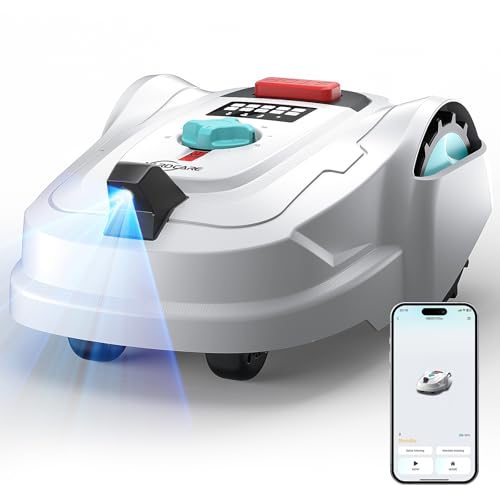
Product images: Amazon listings
Frequently asked questions
Are wire-free robot mowers better?
They are easier to set up and change, but not better everywhere: under heavy tree cover or between tall buildings a boundary wire or a LiDAR model is more dependable than RTK.
What does installing a boundary wire involve?
Laying the loop at the right distance from every edge, a separate island around each tree or bed, a guide wire through narrow passages, and a peg every 40 in at most, per Gardena and Husqvarna.
Do I have to bury the boundary wire?
No. You can peg it on the surface, and the grass covers it within a few weeks per Gardena; bury it 1 to 20 cm deep if you use a dethatcher or aerator.
What happens if the boundary wire breaks?
The mower loses the signal and stops until the break is repaired with a coupler, which is why many owners keep spare connectors.
Sources
- Husqvarna — Automower 520/550 operator's manual (PDF) (consulted Nov 2026)
- Gardena — SILENO minimo operator’s manual, 2025 (PDF) (consulted Nov 2026)
- Gardena Australia — Robotic Lawnmower FAQs (consulted Nov 2026)
- Segway Navimow (copy hosted by EU9) — Navimow i-series user manual, i105E/i108E (PDF) (consulted Nov 2026)
- GPS.gov — GPS Accuracy (consulted Nov 2026)
Products mentioned
- Our review: Mammotion LUBA 2 AWD 3000HX (exact Amazon listing)
- Rating and specs: Mammotion LUBA mini 2 AWD 1500H (exact Amazon listing)
- Our review: Husqvarna Automower 430XH (Renewed) (exact Amazon listing)
- Our review: Worx Landroid L WR155E (exact Amazon listing)